
ArticlesMatch Report
Prague 2026: Two Titles, Two New European Box Lacrosse Benchmarks
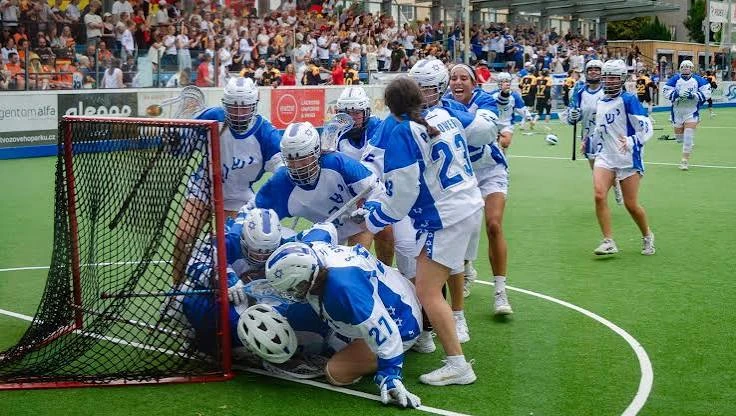
Ireland won a men’s final that stayed live until the closing minutes. Israel turned an early deficit into a women’s final that was effectively decided by halftime. Together, the results redraw the continental pecking order and give the next world cycle two new reference points.
A continental championship with a world-cycle consequence
The 2026 European Box Lacrosse Championships were held in Prague from 25 June to 4 July. Eighteen men’s teams and seven women’s teams competed, making this the largest edition to date, according to World Lacrosse. The tournament was also the first European Women’s Box Lacrosse Championship, so the women’s bracket was creating an official continental order as it played one.
Prague was the third edition of the men’s championship, following Turku in 2017 and Hannover in 2022. England arrived as the defending men’s champion. The tournament also served as a qualifying event for the 2028 World Lacrosse Box Championships, as stated by the Finnish Lacrosse Association. The published sources do not specify how many European places it allocates.
That context matters to the finals. The teams were playing for trophies and for position in the next international cycle. Yet the EBLC is a Box event: its qualification consequence should not be confused with the separate Sixes pathway to Olympic lacrosse at Los Angeles 2028.
- 9–6
- Men’s final. Ireland defeated Finland; quarter scores 3–2, 2–1, 1–1, 3–2.
- 10–1
- Women’s final. Israel defeated Germany; quarter scores 0–1, 5–0, 3–0, 2–0.
- Germany
- Men’s bronze. Third after a 17–9 win over England.
- England
- Women’s bronze. Third after an 11–7 win over Ireland.
The tournament changed status more than it settled access
For Ireland, the men’s gold changes the team’s standing. It leaves Prague as the champion that future European contenders will measure themselves against. Finland’s silver confirms that it remains a leading programme, but the final did not convert that level into the title.
For Israel, the shift is more foundational. This was the first women’s European Box championship, and Israel won it by beating the other two podium teams: Germany in the final and Ireland in the semifinal. The victory creates the first official women’s benchmark for the continent and gives Israel the initial authority that comes with setting it.
The qualification stake was real, but the available records do not establish that either finalist had already secured its 2028 place before the championship. Prague contributed to the European qualification process, while the finals themselves changed each winner’s competitive status. A title is a status shift; it should not be mistaken for proof that a team has completed the next access step.
Ireland–Finland: the decisive advantage was late-game conversion
The official Pointbench game sheet records Ireland’s 9–6 win as 3–2, 2–1, 1–1 and 3–2 by quarter. That sequence matters more than the final margin: Ireland led throughout, but never built a cushion large enough to make the final quarter routine.
| Team | Q1 | Q2 | Q3 | Q4 | Final |
|---|---|---|---|---|---|
| Ireland | 3 | 2 | 1 | 3 | 9 |
| Finland | 2 | 1 | 1 | 2 | 6 |
The hinge was not a single goal but Ireland’s repeated answer to Finnish pressure. Ireland moved from 5–2 to 5–4 as Finland scored once at the end of the second and again early in the third. At 42:22, Conor Foley restored a two-goal gap at 6–4. Finland narrowed it to 6–5, Ireland moved to 7–5, and Finland again reduced the margin to one at 7–6 with 5:13 remaining.
That comeback was real, but it did not become a takeover. Foley scored at 56:06 to make it 8–6, and Brian Gillis added a shorthanded goal at 59:36. Ireland converted the two possessions that ended the contest while Finland’s final push was still within reach. The late shorthanded goal was insurance; the earlier response after Finland’s 7–6 was the moment the final’s logic changed back in Ireland’s favour.
World Lacrosse reports six combined points for Foley and Gillis. The official scoring record credits Foley with three goals and Gillis with two, including the shorthanded finish. Irish goalkeeper Devlin Shanahan made 35 saves. Those numbers point to a concentrated scoring burden and a major goalkeeping contribution. Possession and shot-quality figures are not available.
Israel–Germany: the second quarter turned a deficit into separation
The Pointbench final sheet records a 10–1 Israeli win, with Germany leading 1–0 after the first quarter. The title was not decided by a dominant opening. It was decided by Israel’s response: five unanswered goals in the second quarter, followed by three more in the third.
| Team | Q1 | Q2 | Q3 | Q4 | Final |
|---|---|---|---|---|---|
| Israel | 0 | 5 | 3 | 2 | 10 |
| Germany | 1 | 0 | 0 | 0 | 1 |
At halftime, Israel had turned a one-goal deficit into a 5–1 lead. By the end of the third, the score was 8–1. Germany did not score again after its opening goal. This was the decisive structural pattern: Israel shut down Germany’s scoring after conceding first, while its own offence kept converting across successive quarters. The game’s control was visible in both halves of the scoreboard, not only in the final margin.
World Lacrosse credits Julia Rowland and Hanna Hilcoff with hat tricks in the final. The same report records Ava Pinch at an 88% save rate across eight games and says Israel conceded an average of 3.1 goals per game. These tournament-wide figures support the view that Israel’s title rested on sustained defensive performance as well as the final’s scoring run. They do not, by themselves, explain shot volume or the relative contribution of the full roster.
Germany had earned its place in the final and finished second in the inaugural event, so the 10–1 score should not erase its broader achievement. But the final exposed a specific ceiling in that matchup: once Israel’s second-quarter run began, Germany found no scoring response to interrupt it. Israel, by contrast, turned a first-quarter setback into an eight-goal lead by the end of the third.
The standings redraw the hierarchy, but do not settle it
Ireland becomes the men’s team to defend against. The final shows a team able to close under pressure, but also one that relied heavily on Foley, Gillis and Shanahan in the title game. The championship raises expectations: future opponents can prepare for a proven finisher, while Ireland must show that its late-game control and scoring production survive targeted pressure on its central contributors.
Finland remains a contender, with a precise problem to solve. Its comeback reached one goal, but it could not create the tying sequence before Ireland restored a two-goal margin. The evidence points to late possession conversion and defensive handling of the opponent’s answer, not to a general inability to compete at this level.
Israel owns the first women’s reference point. Winning the inaugural championship gives Israel more than a medal: it defines the standard other European programmes will now measure against. The margin in the final and the defensive record across the tournament make that authority unusually clear for a first edition. It still has to be defended in future competition; the title is a starting position, not permanent proof of dominance.
Germany and host Czechia leave Prague with different readings. Germany won silver in the women’s competition and bronze in the men’s, a two-bracket result that signals breadth. Czechia finished fifth in the men’s standings and sixth in the women’s. Hosting placed the country at the centre of the sport’s largest European Box event to date, but home status did not translate into a podium. That gap is a more useful measure of the host programme’s current competitive ceiling than the visibility of the event itself.
Across the field, Ireland, Finland, Germany and Israel emerged with medals; England took fourth in the men’s competition and bronze in the women’s. These results create a more differentiated hierarchy than a single “top nation” label: Ireland sets the men’s title benchmark, Israel the women’s, Finland remains within reach, and Germany shows cross-competition depth.
The internal rebound is about repeatable control
Ireland: preserve the ability to finish close games while reducing the windows in which a late opponent run can erase a lead. The final confirms that the team can produce under pressure; it also makes the concentration of points among Foley and Gillis worth monitoring. The next question is whether the scoring burden can be spread without losing late-game clarity.
Finland: convert the possession after a comeback goal into a chance to tie, and prevent the opponent from restoring a two-goal margin immediately afterward. The 7–6 score gave Finland a live route back. The final moved away when Ireland scored next and Finland could not answer again.
Israel: retain the defensive response that followed Germany’s opening goal, while ensuring the attack does not depend on one explosive quarter to create separation. The five-goal second quarter changed the match, but the three further goals in the third showed that Israel sustained pressure after the initial run.
Germany: identify how to interrupt an opponent’s unanswered run. After going ahead 1–0, Germany conceded eight consecutive goals across the second and third quarters. The priority is a defensive and possession reset that produces a scoring response before the game’s structure is lost.
Czechia: turn the experience of hosting a record-sized tournament into competitive depth. Fifth and sixth place are solid home results, but not evidence of podium-level control. Future progress will depend on roster depth, the ability to create scoring across all four quarters, and converting home-floor experience into results against the leading programmes.
What the score actually changes
Prague changed the owner of the men’s European title and created the first women’s champion. Ireland’s 9–6 win says that it can finish a final when a comeback makes the margin fragile; it also gives Ireland the pressure of defending a title earned through a narrow closing stretch. Israel’s 10–1 says more than “dominant final”: a first-quarter deficit became a sustained defensive shutdown and a first continental benchmark. The score changes status and expectations. Qualification for the 2028 Box Worlds is a separate outcome, set by the official allocation and team entries.
Sources
- Pointbench official game sheet: Ireland–Finland men’s final: quarter scores, goal chronology, scorers and penalties.
- Pointbench official game sheet: Israel–Germany women’s final: quarter scores and individual scoring record.
- World Lacrosse: Ireland men and Israel women claim gold: final narratives, full standings, key scorers and goalie statistics.
- World Lacrosse: 2026 championships set for Prague: tournament dates, team counts, history and event context.
- Finnish Lacrosse Association: Men’s Box national team: identifies the European Championship as a qualifier for the 2028 World Championships.
- European Lacrosse Federation: Eligibility: eligibility framework and World Lacrosse competition rules context.
Possession shares, comparative shot quality and full roster contribution rates are not published. The analysis rests on the official scoring sequence, published goalkeeper figures and tournament standings.
Continue reading
React to this article
A correction, a missing club, a source we should read: tell the desk.
Write to FTL